Student GIS Projects

I’ve been teaching the Introduction to Geographic Information Systems (GIS) class in the Earth, Environmental, and Sustainability Sciences (EESS) Department for about 11 years. Suresh Muthukrishnan (department chair) also teaches the course. I’ve learned a ton from him. Here are some things I really enjoy about teaching the course:

House flipping hotspots near the Cincinnati Streetcar route. An example map from student Charlotte Moore.
  • Interdisciplinary Nature – Students from across campus take the course. Of course, there are lots of EESS majors. However, even those projects run the gamut. Projects like geologic mapping, landslide risk, sustainable farming, and even mapping data from GPS collars on mountain lions. But students of history, economics, sociology, computer science, business, and music also come up with some great projects.
  • The Opportunity to Learn – Every semester, students will come up with novel questions and methods. I think my typical response is, “I haven’t done that before, but I know it’s possible. Let’s figure it out together.” So I learn something new about GIS, as well as all the topics above, each time I teach.
  • Community Connections – Many of the projects involve community partners–folks like the Greer Police Department, Upstate Warrior Solution (which serves veterans), Greenlink (our public transportation department), local land conservation non-profits, the forestry department, and community associations. Our first deep partnership involved mapping streetlights, which I’ll talk about in another post.
  • Working with Our Post-Baccalaureate Fellows (postbacs) – I’m grateful to get to work with two recent Furman graduates who are on our team. Catherine Lippert (Sustainability Science) and Sam Hayes (History and Politics and International Affairs) are an integral part of teaching the course. They have serious GIS chops and roll up their sleeves to help the students with projects, every step of the way.
  • Project-Based Learning – The course involves a semester-long project. It’s a real challenge to teach GIS principles, create meaningful labs, AND support students as they use these concepts and tools to apply what they’ve learned to address a real-world problem. Every semester I think, “We took on too much. This isn’t going to happen.” But it always comes together. Here’s the syllabus for the class.
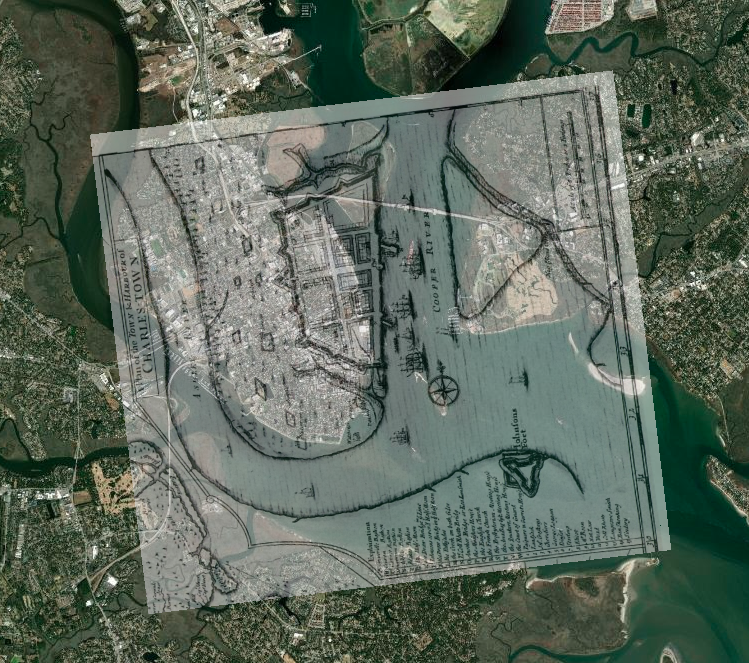
An historic, georeferenced map of Charleston Harbor (1711). From a student project by Kylie Gambrill.

Here are some examples from a recent class. I don’t want to make it seem like I’m taking credit for these. The students did the work. Catherine, Sam, and I were teammates. However, the examples are illustrative of the range of projects that are possible. The projects are easier to share, now that we have switched the delivery format from poster presentations to StoryMaps.

Charlotte Moore: Transit-Motivated Gentrification: An analysis of gentrification in Over-the-Rhine, especially as a result of the Cincinnati Streetcar.

Caroline Vickery: Contextualizing Upstate Farms: A preliminary examination of land use and nutrient loading for small farms in the Upstate of South Carolina.

Kylie Gambrill: Understanding Change: The Charleston Harbor — Our perceptions of the environment around us depend upon the cultural context we find ourselves in.

Bennett Dean: Affordable housing and public transportation in Greenville.

 Chloe Sandifer-Stech: Recommendations for green space around Enoree Career Center: A study of the influence of tree density on carbon storage.

Jake Gerardi: Land Sparing/Sharing Impacts on Birds: Assessing habitat quality of southern bird species using ecological principles in Greenville watersheds.

Madison Eichhorn: Affordable Housing & Good Jobs – An evaluation of proximity, density, and availability of affordable housing and employment.

Austyn Feigenbaum: Boating Safety Zones and Florida Manatees: An investigation on the relationship between manatee death rates and boating safety zones along the coast of Florida.

I hope you’ve enjoyed seeing the range of student projects and learning more. It’s a pleasure to see all the hard work result in such great studies and stories.

Discussing the reading in class. Students as designers.

I’m truly impressed by colleagues who can effortlessly lead an engaging class discussion about a particular reading. I’m not that person. It’s a lot of work for me. While I find myself comfortable discussing concepts like conservation of momentum, acceleration, and projectile motion in class, I often feel out of my element when pulling together a strategy for discussing an outside reading for a book like Case for Mars (see earlier review). I really wanted to move beyond my current strategy of “summarize the 3 main ideas that grabbed you most”, which seems to inspire a pretty shallow read and makes me feel like that teacher in Ferris Beuller’s Day Off.

I thought I’d share something that seemed to work.

Engaging Ideas, by John Bean, has some great ideas for lesson design, including focusing on problems as an entry point. There’s a ton of literature out there on problem-based-learning, but something about Bean’s style (concrete and concise) seems to resonate with me and spur new ideas (almost as much as going on a run). When a friend first recommended this book, I initially thought it wouldn’t be helpful for a science teacher. Man, was I wrong.

engaging-ideas

The Case for Mars chapter we read focuses on strategies for getting to Mars and outlines contingencies provided by different plans. It’s fairly content rich, and I’d decided that I wanted to present the students with a mission mishap and ask them to analyze the options offered by each of the mission plans. After sharing my struggle to come up with a good problem with my teaching partners in crime, Sarah, our creative and talented TA, said, “Let them come up with the problem themselves and exchange it with another group.” Brilliant!

Here’s the scenario we presented to the students (zubrin-contigencies.pdf).

From my perspective a great deal of learning took place during the session, and the seemingly minor change of having the mishap designed by the students made a real difference. I don’t have a control group for comparison, so in the future I’d like to see what happens with the same assignment when I generate the problem. 10 bucks says it doesn’t go as well.

Some highlights:

  • Students were diagramming the different plans, flipping back through and rereading the book, and critically analyzing each of the options. I don’t think this happens as readily if I just say, “Read Chapter 4.”
  • The portable whiteboards seemed to help students organize and efficiently present their ideas. You can make these on-the-cheap from materials at Lowe’s or Home Depot (see below). They’ve been willing to cut these to size in the store.
  • Students were teaching one another. I asked a lot of questions. I know I’m supposed to do that anyway, but the context of the problem made it flow more easily.
  • It set the stage for more accountability and a different (and better) approach to future readings.
  • They did a great job critically analyzing each of the plans and were able to concisely share their thought processes and conclusions at the end of class.
  • Tech required – whiteboards, books, caffeine.
  • Their mishaps were much better than mine would have been.
  • I had fun.

white-board

Cut this into pieces and you have pretty cheap, portable whiteboards.

Thanks for the great lesson idea, Sarah!

Mars Phoenix converts a Twitter skeptic

I’ve been very skeptical about educational uses of Twitter, but I have to admit that a little lander on Mars has changed my mind. This fall I’m teaching a course for non-science majors that centers around exploring the physics, chemistry, and geology surrounding a manned space mission to Mars. When I found out the Mars Phoenix Lander was providing mission updates via Twitter, I decided to take the plunge.

The lander (through a ghost writer) sends out tweets, sometimes several times a day, with mission updates which I follow through Twitterific (screen shot below).

Twitter Mars

One of the objectives for the course is for students to get a real sense of the scale, terrain, and environment of Mars. That’s not something that gets accomplished through a single lesson. Having the students subscribe via Twitterific or text message updates (I haven’t sprung for the extra $ to get into that) seems like a great, subversive way, to weave Mars into the daily lives of students. Phoenix “tweets” have often led me on a curious quest for more info, and I’m hoping it will do the same for students.

I was psyched to learn that the mission had been extended (through a tweet, of course) to the end of September, so I can use this for at least part of the upcoming semester. Here’s just one example (of many) of a great pointer from Phoenix, which can be used to address common misconceptions about the cause of the seasons.

Mars midnight sun

Clipped from JPL site.  See http://www.jpl.nasa.gov/news/phoenix/images.php?fileID=15091 for full story.

Oh yeah, here’s a link to the famous Private Universe video showing interviews with Harvard grads that demonstrates just how tenacious this misconception can be.

If Twitter can help, I’m in!

Link to Mars Phoenix tweets / twitter page 

Costa Rica Day 6 and home

See flickr for all the pics from the trip.

Got up early to go with a crew over to Firestone. They were casting nets to catch leaf litter for another study on the property. I caught up with some email and talked to Susannah briefly before heading back for more GIS instruction. I really learned a lot. Warren is a great teacher and very patient with all of us. We turned data we gathered with the clinometers and compasses into latitude and longitude using start and finish anchor points we took with the portable GPS devices and COMPASS software. Then we imported all the data from the surveys we had done to see the additional trail maps. It was way cool! All of the points help GIS interpolate elevation, slope, and aspect information, so we get a better handle on both the Hacienda Baru and Firestone property.

eric mapping

I took a quick walk by myself on the trail to the playa (beach). We ate a quick lunch, packed, and took a different route back to San Jose. This road was paved, but very curvy, with some drops that were pretty impressive. I was happy for dramamine and decided it wasn’t worth watching all the crazy passing we were doing on hair-pin turns.

Carol on steep cliff

We stopped at a little over 8,000 ft on the way up and climbed a peak for some great views (see flickr). On the way back into the bus, we ran into a young guy from Japan who had biked from Calgary Canada!! He was looking for a place to pitch a tent for the night. He seemed to be in great spirits for such a long uphill ride with crazy traffic all around.

Mike and Jose Luis

We went out for dinner in San Jose, which is hopping in the evening. Jose-Luis and I (picture above) crossed a street and got stuck in the middle of the road. No one let us go and just honked and whizzed past. I later asked Eric to teach me how to curse in Spanish. I have a couple of phrases in my back pocket that might serve me well in the future 😉 I’m on the plane home to Atlanta, then I drive back to Greenville. Can’t wait to be home, but it was a great trip!

Costa Rica Day 4 and 5

It’s Thursday night before dinner. Just catching up on the events of the last couple of days. Wednesday we surveyed most of the day – the main trails of Haciendu Baru in the morning, then up the slopes towards the overnight camp during the afternoon. The afternoon trip was especially beautiful, and we met up with the group that had hiked up to the top of the ridge, then back down, to connect the surveys.

sloth

We saw monkeys in both the morning and afternoon. They were especially active during the late afternoon hike back down the ridge. See flickr for snapshots. I didn’t take too many photos since we were so busy. Surveying got easier as we went. The challenge was getting a decent compass reading on some of the steeper slopes. The work was tedious but pretty rewarding when we saw the final survey. Stayed up late talking GIS with Kate, Travis, and Warren.

monkeys

Thursday morning. Not feeling well at all. We had a choice to stay for detailed GIS instruction or survey in the river or up near the overnight camp towards the Firestone property. I volunteered for the latter if they needed bodies, but they had enough, so I stayed put. Probably a wise choice based on how I was feeling, but it sounds like both groups had great and strenuous hikes. As the groups left, they caught site of a baby sloth in a tree near the trail. We went over to snap some pictures. It was really close, so I got some great shots. Man, they don’t even look real and are definitely low energy – like me on Saturday morning.

Rain moved in just as the groups were returning. The group that went up to the overnight camp ran into an fer-de-lance. Pedro, the guide for this section, lightly stepped on the head of this highly venomous snake and pinned it with a forked branch, while the rest of the group snapped some photos. Keith said he’d send the shots, and I’ll post his pics soon. It looks like the snake was hot on the trail of lunch, a garter snake, and his would-be prey was also caught on film.

A little more GIS work in the afternoon. I opted out of gathering GPS data on the nearby trails and volunteered to pick up the group hiking the 5k road back to Baru in the car as the storms rolled in. They were pretty close by the time I caught up with them. Pretty low energy day, but I learned a lot of GIS details.

Haven’t had access to phone or internet since Tuesday, so I hope Susannah and the kids aren’t too worried. But there’s really no way to contact them. Hopefully I can put in a call on Friday to them from the Firestone station.

We take a trip back to San Jose up the steep side tomorrow, then head out Saturday morning for home. It’s been a great trip so far! Can’t wait to see Susannah and the kids though.

Costa Rica Day 3

It’s Weds. morning before 8 am and already incredibly hot and steamy. Today is going to be a scorcher. The power died this morning, so I’ll have to type quickly on battery power. Yesterday morning (Tuesday) we hiked the Firestone reserve property taking the North trail along the boundary of the property. We hiked along the river to the waterfall (see flickr pics) and then up the trail for a steep 1,000 ft ascent to the ridge where we met up with the team geocoding the numerous petroglyphs on the site. I took a few snapshots of the petroglyphs, and I think the running total for this ancient rock art is now over 50 on the 300 acre property. Bamboo was planted back when the property was pasture, and it’s really taking over up top. Right now contractors are cutting and treating the wood on site for use in local sustainable building initiatives to keep growth in check. We climbed the bamboo ‘tree fort’ and looked at several petroglyphs while on the ridge, then caught a ride down the mountain with the contractor.

rest

The station was abuzz with student researchers, one of whom described her research to study the impact of the clearing effort on the thickness of remaining bamboo growth. She cautioned about the many snakes she’d seen that morning and commented, “Geez, I hate snakes”. Lunch was great. I’m getting hooked on fresh mango and pineapple.

After lunch Warren went over some GIS information, and we learned some surveying techniques using compass bearings and inclination measurements. It really takes a steady hand and some patience to get good readings. After that we surveyed a loop on the property and then ran the data through COMPASS software to determine our loop closure error which was less than 2%. Not too shabby! Travis did a great job with measurements.

Back to the property for dinner, a little more GIS instruction, and a great slideshow from Keith and Don (the bat experts) on some visits to caves in Panama. I was going to run on the beach this morning and opted for an extra hour of sleep instead. Determined to try tomorrow am, my last chance, I think.

Today we stay on the Haciendu Baru to survey in the lowlands, so we can connect to the Firestone surveys. That means hot and buggy and no internet, since we only get that at the Firestone station. I’m anxious to gather real rather than practice data. I had a quick Skype conversation with Susannah before the kids got out of school, and it worked pretty well. I miss her and the kids a lot and am bummed that it will be another day before I can communicate with them in any shape or form.

Man, it’s hot today, and it’s not even 9 am. More tomorrow. More pics from Tuesday added to flickr. Check ’em out.

Costa Rica Day 2

We’re now at the Hacienda Baru, after a long, bone-jarring and motion-sickness-inducing ride down the mountain and past palm oil plantations. I posted pictures on my flickr account which includes a shot of one of the oil palm processing plants along the route.

The cabins are nice with loads of fans to take the edge off the damp afternoon heat.

We got in late afternoon but still had time for a quick hike in the property. It’s beautiful. We hiked down to the Pacific ocean as the sun was starting to set and hiked back using flashlights while within the canopy. It was still light enough outside the canopy that we didn’t need artificial light. There were quite a few bats buzzing us on the walk back and apparently this is the trail where they saw a fer-de-lance last year. Nothing this time – phew!. See flickr for photos from the hike.

beach 1

After dinner on the property, we headed back to the cabins. On the way we saw two large frogs. We got so into tracking down the frogs that we failed to realize we were standing on an ant hill (probably the frog’s source of food). Once the biting began, we quickly realized we were covered in ants and started the appropriate swatting and dancing routine until the little buggers were gone. Ouch.

Got up around 5 am and starting composing email and the blog, so that I could make the most of internet time today, if we get it. Off to the Firestone Preserve to check out the property and start GIS training in the afternoon.

Oh, I almost forgot. Check out the crocs we saw at lunch. They’re huge!

Arrived in Costa Rica

Arrived in San Jose, Costa Rica last night and walked around for a short time this morning. We leave in a few minutes for the coast to start our mapping of the area between the Firestone Preserve and the Hacienda Baru. Off to view some crocodiles. Here are a few quick pics from outside the hotel in San Jose.

san jose 1san jose 2

Concept Map Software Demo – CmapTools

CMapTools is concept map software which is available free for educational use. I created a quick demo of some of the main features. I especially like the support for mulitmedia objects.

super hero small

Oops! See this 60 sec correction / tip for saving space in your concept map.

Of course, there are many academic uses, but the above superhero example is kind of a fun intro (see more detailed, finished super hero map here). For example, the Science Education Resource Center (SERC) at Carleton College has some great information on using concept mapping in the geosciences.

Science Projects and the NFL

eyeblack experiment The upcoming NFL matchup between the Packers and the Giants on the frozen tundra of Lambeau field this Sunday helped my youngest daughter design an experiment for her upcoming science fair project. She’s been studying heat, so we’ve been discussing what Green Bay fans can do, if anything, to stay somewhat warm during the game.

I’ll share more details once we have data, but it’s the second NFL-inspired project we’ve undertaken in the last few years. The strange picture above was taken during experiments carried out by my oldest daughter when she was in second grade. We were wrestling with science fair project ideas and took a break to watch football when she asked, “Dad ,why do they wear that black stuff under their eyes?”. A visit to the wig shop (for the styrofoam head) and the sporting goods store, along with a borrowed light meter, provided the raw materials.

indoor eyeblack

We didn’t see a difference indoors or outdoors in the amount of light entering the eye, but she conjectured that the light meter doesn’t have the same kind of peripheral vision that we do. She didn’t use those exact words of course.

While we were experimenting, Ricky Proehl (pictured below), then wide receiver for the Carolina Panthers (and fellow Wake grad, I might add), was signing autographs at a nearby sporting goods store. My daughter took the opportunity to ask him a few questions, since he wears eye black. He admitted that there might be a bit of habit and superstition involved, but he felt it really helped him see better, especially indoors. He was really friendly and patient and seems to be a great a guy. We added the eye black with photoshop.

Ricky Proehl

More formal studies seem to suggest it helps with glare and contrast sensitivity and that the grease is better than the stickers. Plus it looks tough! That’s the real reason I wore it while playing high school baseball, since my hitting wasn’t going to impress any girls. I even remember swiping grime out of the tail pipe of my car before one game because I ran out. Gross.

Go Packers! With wind chills way below zero, light glare is going to be the least of the players’ worries this weekend.