Student GIS Projects

I’ve been teaching the Introduction to Geographic Information Systems (GIS) class in the Earth, Environmental, and Sustainability Sciences (EESS) Department for about 11 years. Suresh Muthukrishnan (department chair) also teaches the course. I’ve learned a ton from him. Here are some things I really enjoy about teaching the course:

House flipping hotspots near the Cincinnati Streetcar route. An example map from student Charlotte Moore.
  • Interdisciplinary Nature – Students from across campus take the course. Of course, there are lots of EESS majors. However, even those projects run the gamut. Projects like geologic mapping, landslide risk, sustainable farming, and even mapping data from GPS collars on mountain lions. But students of history, economics, sociology, computer science, business, and music also come up with some great projects.
  • The Opportunity to Learn – Every semester, students will come up with novel questions and methods. I think my typical response is, “I haven’t done that before, but I know it’s possible. Let’s figure it out together.” So I learn something new about GIS, as well as all the topics above, each time I teach.
  • Community Connections – Many of the projects involve community partners–folks like the Greer Police Department, Upstate Warrior Solution (which serves veterans), Greenlink (our public transportation department), local land conservation non-profits, the forestry department, and community associations. Our first deep partnership involved mapping streetlights, which I’ll talk about in another post.
  • Working with Our Post-Baccalaureate Fellows (postbacs) – I’m grateful to get to work with two recent Furman graduates who are on our team. Catherine Lippert (Sustainability Science) and Sam Hayes (History and Politics and International Affairs) are an integral part of teaching the course. They have serious GIS chops and roll up their sleeves to help the students with projects, every step of the way.
  • Project-Based Learning – The course involves a semester-long project. It’s a real challenge to teach GIS principles, create meaningful labs, AND support students as they use these concepts and tools to apply what they’ve learned to address a real-world problem. Every semester I think, “We took on too much. This isn’t going to happen.” But it always comes together. Here’s the syllabus for the class.
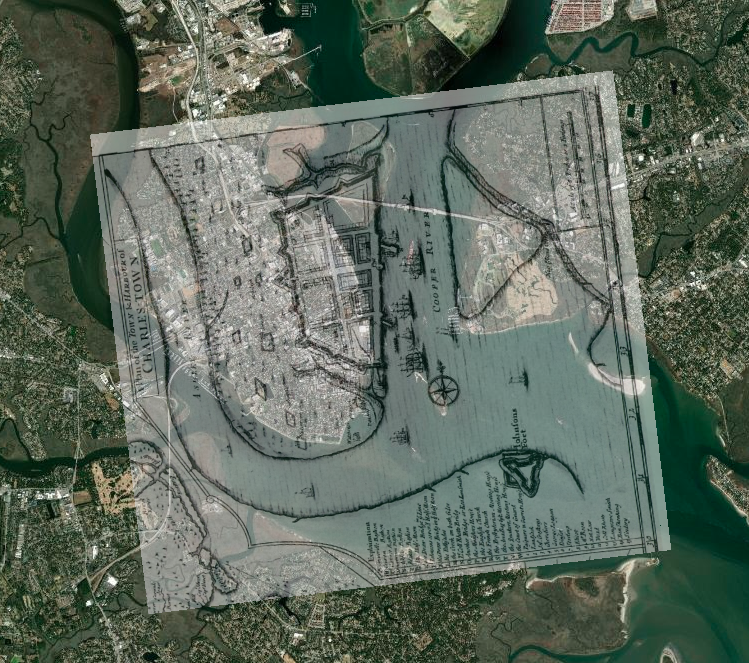
An historic, georeferenced map of Charleston Harbor (1711). From a student project by Kylie Gambrill.

Here are some examples from a recent class. I don’t want to make it seem like I’m taking credit for these. The students did the work. Catherine, Sam, and I were teammates. However, the examples are illustrative of the range of projects that are possible. The projects are easier to share, now that we have switched the delivery format from poster presentations to StoryMaps.

Charlotte Moore: Transit-Motivated Gentrification: An analysis of gentrification in Over-the-Rhine, especially as a result of the Cincinnati Streetcar.

Caroline Vickery: Contextualizing Upstate Farms: A preliminary examination of land use and nutrient loading for small farms in the Upstate of South Carolina.

Kylie Gambrill: Understanding Change: The Charleston Harbor — Our perceptions of the environment around us depend upon the cultural context we find ourselves in.

Bennett Dean: Affordable housing and public transportation in Greenville.

 Chloe Sandifer-Stech: Recommendations for green space around Enoree Career Center: A study of the influence of tree density on carbon storage.

Jake Gerardi: Land Sparing/Sharing Impacts on Birds: Assessing habitat quality of southern bird species using ecological principles in Greenville watersheds.

Madison Eichhorn: Affordable Housing & Good Jobs – An evaluation of proximity, density, and availability of affordable housing and employment.

Austyn Feigenbaum: Boating Safety Zones and Florida Manatees: An investigation on the relationship between manatee death rates and boating safety zones along the coast of Florida.

I hope you’ve enjoyed seeing the range of student projects and learning more. It’s a pleasure to see all the hard work result in such great studies and stories.
Reflecting on Projects

Partnership with United Way of Greenville County: Neighborhood Assessment

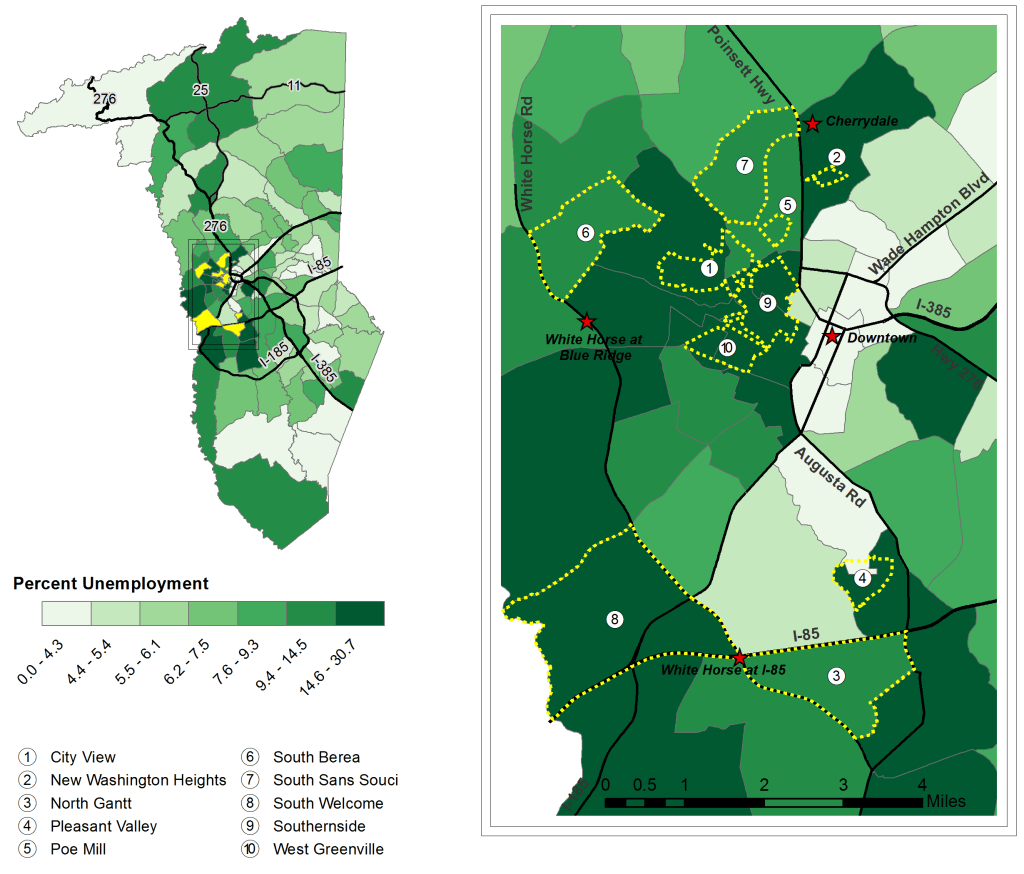
Percent Unemployment: Greenville County and Ten Focus Neighborhoods.

I’ve been going through the course, Visualization for Clarity, on the FlowingData website. I’ve learned a great deal and decided to use it as an opportunity to go back through previous work and projects to analyze what we did right and what we could have done differently. 

  1. Firstly, I wanted to put highlights from the projects in one place. Some of these resources are difficult to find. So I wanted to pull them together in one place. So that’s a question for action: How do we make our work easier to find, so that the information can be leveraged for positive change? See the full report and executive summary for details on this project.
  2. I hope this exercise will prompt me to reflect on our work. I say ‘our’ because almost all of the work I’ve done has been with teams. Although I like to hole up and make maps and other visualizations myself (usually playing punk music and drinking homemade cold-brew coffee), I love working in teams. Part of it is selfish; I just learn so much by working with others.
  3. The last reason is professional. It’s difficult to share this kind of work in a CV/Resume. I want to get it out there–get feedback from a broader audience and connect more deeply with a GIS / DataViz community.

So here’s one from the recent past.

Project Title: Focused Needs and Assets Assessment – Greenville County, SC

Team members: See the list in the report. It was a big, team effort. 

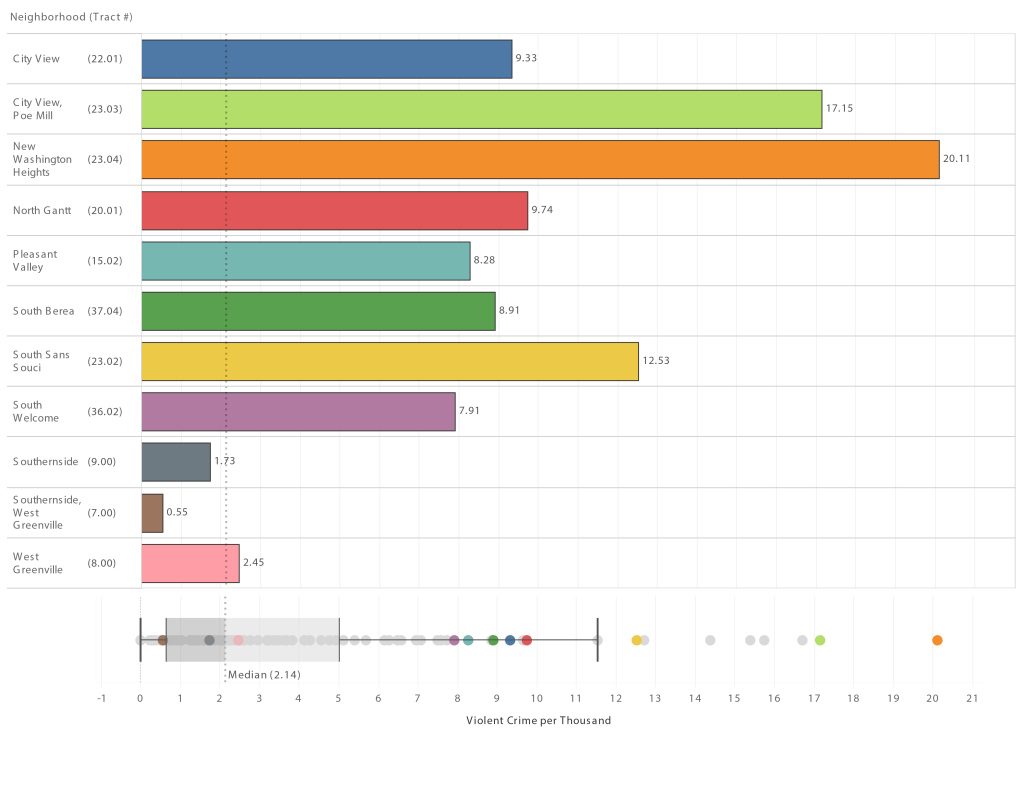
Violent Crime in Ten Study Neighborhoods: Data from Greenville Police Department.

Summary: 

  • We focused on 10 neighborhoods with the highest family poverty rates in Greenville County. This focus was determined in collaboration with the United Way of Greenville County. 
  • We then sent teams of qualitative researchers, including students, into these neighborhoods to better understand assets and needs. That team met with 268 neighborhood stakeholders! We wanted to make sure to focus on assets just as much, or more, than needs. As you can probably guess, these varied greatly from neighborhood to neighborhood.
  • Our team mapped and graphed 35 measures of community well-being, highlighting each of the ten neighborhoods. 
  • Because of United Way’s focus on a cycle of success, particularly third-grade reading scores, our team re-aggregated the data to local school attendance zones to analyze explanatory variables for reading scores. See the full report or executive summary. The most interesting one to me was the potential role in communities with high alternative workshift rates (e.g., second-shift, third-shift, etc.). Professor John Quinn took the lead on this analysis. 

Tools used for visualizations, maps, and modeling:

  • ArcGIS Desktop
  • QGIS
  • R
  • Tableau
Financial Measures Broken Down by Neighborhood and Tract Number. Darker Green Shows Higher Percentage or Dollar Amount.

Visualization Reflection:

The good

  • I think we did a great job with maps and visuals, e.g., color choices, visual hierarchy, highlighting local landmarks, and other map-making best practices.
  • I also like the tables for the measures of well-being (see above). Sometimes tables are better than a fancy visualization. This is a good example. The color shading in the table really draws the eye towards certain neighborhoods.
  • I really like the asset and need visualizations in the executive summary (see below). This was Dr. Matt Cohen’s idea. We implemented that with Tableau.
Community Assets. Identified by Community Members and Stakeholders.

Opportunities for Improvement:

  • Interactivity – It drives me a bit crazy when great information isn’t interactive. We locked this into PDF format for the report. In our defense, we had limited time and budget, so we decided not to pursue interactive platforms like Tableau Server and ArcGIS Online. We fixed that in future projects. How cool would it have been to have to be able to hover over a particular neighborhood and see it highlighted in our box and whisker plot? I could do that in Tableau Desktop, but it would have been helpful for our stakeholders to do that too. 
  • Updatability – We put a lot of work into pulling data in tabular form, cleaning it up, re-aggregating it to non-standard boundaries. Now the data is stale. We need to take a step back and explore ways to develop frameworks that allow us to “slide” new data underneath (like new ACS estimates) and have maps and graphs auto-update.

An unplanned semester online:

Like my students, I’m struggling with the shift to online. I’ve used screencasts (short recorded lectures) previously, but I’m re-evaluating. I like them because they are a compact way of sharing content and context. Most are in the 7 – 20 minute range. But here are the challenges:

1. Time to produce – I know it’s hard to believe, but this one took me about 4 hours to a) get the data wrangled 2) put together an outline 3) record, and 4) edit. So I, either suck at this, or my experience is indicative of other instructors’ experience. I’m open to the former.

https://furman.box.com/s/no1ui4cwbwnrud6vuqm02q10kk1zrppm

2. Time in-class vs. online lecture – This would have taken 2x the time to discuss in class. The presentation wouldn’t have been as tight, and student questions/discussions would have extended the time. But is that “time gain” a good thing, or indicative that something is missing online?

3. Lecturing to no one – You might hear it in my voice, but it’s hard to lecture to an imagined audience. I try to envision my students, and I’ve even stood up to produce the screencast with more energy, but recreating the in-person experience is tough. I miss them.

4. The long term – I think I can use these screencasts, which are primarily information dissemination and demonstrations, to make space in my class for more interaction and discussion. However, that’s going to have to happen in person, or it’s one more thing to figure out how to do online. Zoom breakout groups are great, but are they the same thing as in-person discussions?

Some questions:

  1. Do you find that developing screencasts is worth the time?
  2. A similar, live lecture via Zoom is going to take longer, but is the interactivity worth it?
  3. How do you use short screencasts to make room for my interactivity during synchronous meetings, whether online or in-person?
  4. What went well online this semester? What were the challenges?


Lessons from 1918

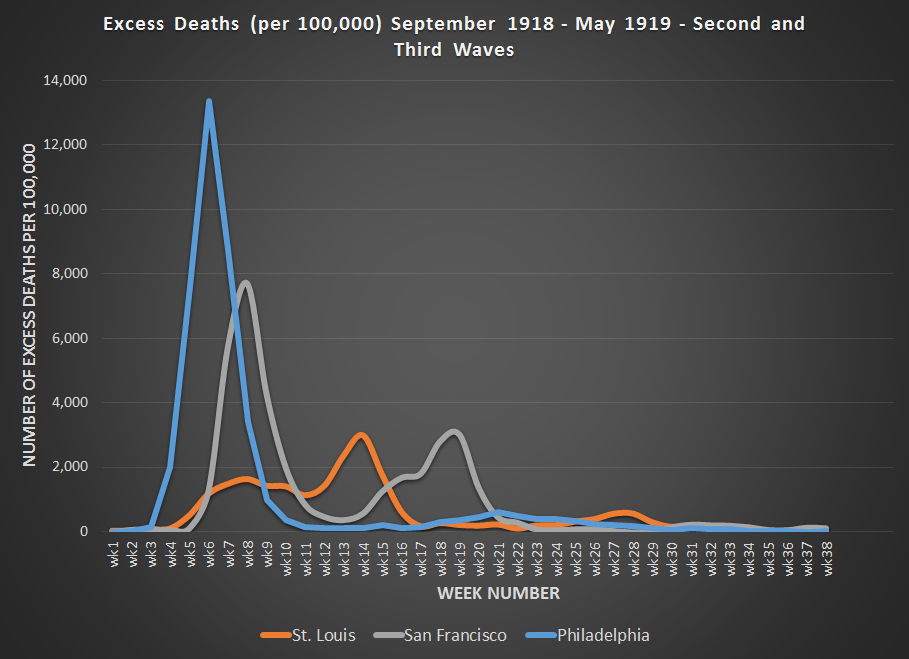
After reading this article about how different cities handled the 1918-19 flu pandemic, I decided to get the data graph it. You can see the impact, and the result of St. Louis and San Francisco letting their guard down too early—despite stronger responses in the early phases.  It appears SF likely overestimated the effectiveness of masks in preventing the spread of this particular virus.

I realize the that virus and Covid-19 are different, but perhaps there’s still a lesson to be learned from history.

Philadelphia (1918) – It’s just like the regular flu. Just keep your feet dry and your bowels open. We’re not canceling the parade.

St. Louis (1918) – This is serious. Avoid crowds. Treat people in their homes if possible. Act early.

San Francisco (1918) – This is serious. Implement social distancing. Wear masks.  

Data source below:

Collins, S. D., Frost, W. H., Gover, M., & Sydenstricker, E. (1930). Mortality from influenza and pneumonia in 50 large cities of the United States, 1910-1929. Ann Arbor, Michigan: Michigan Publishing, University Library, University of Michigan.

Designing In-Class Activities in the Flipped and Blended Learning Classroom: An Example

Overview:  This post provides information about blended learning / flipped classroom modules that we developed for classes that involve creating and analyzing maps.  I briefly discuss the reasoning behind our design as well express my hope that more of the dialog surrounding blended learning and flipping the classroom will focus on resources that help guide the design of effective in-class activities. The modules can be found at https://sites.google.com/a/trinity.edu/acs_grant_gis/home .

There’s been a great deal of chatter recently about the “flipped classroom” and “blended learning”.  If we’re to have deeper dialog, I think it’s important to note that the real conversation is about design. Effective teachers strive to design environments (whether physical or digital) that set the stage for in-class interactions that are rigorous, robust, analytical, dynamic and lead to deeper learning.  Online components are a great resource to help optimize time together; however, the design process is much more complicated than simply inverting in- and out-of-class activities. I’m grateful that these new terms have the potential to inspire a renewed focus on assignment and course design, but the idea behind the flipped classroom is hardly new. Much of our work with faculty at the Center for Teaching and Learning has revolved around designing strategies that help move in-class activities away from the dissemination of information towards more active student analysis and synthesis. Instructors have been doing this long before these terms became popular.

Much of the recent discussion seems to be about moving current lectures online (and the technology to enable this), with class time being used for having students “work in groups to solve problems”—almost as an afterthought.   I’m hoping the dialog will continue to evolve to include more discussion about how to design these in-class sessions more effectively so that students do more than just work in parallel or share algorithms.  Designing these in-class activities is difficult and where the rubber truly meets the road. Simply putting students in groups (after they’ve watched a lecture online) to solve poorly designed problems is a recipe for failure and frustration.  Flipped interactions which hinge on poorly designed in-class sessions are unlikely to promote deeper conceptual understanding and realize the full potential of supplementing classes with online resources.

Just a few resources for designing better in-class problems that I’ve found to be helpful:

Now it’s time to put my money where my mouth is. Through a grant from the Associated Colleges of the South, I’ve been working with Jeremy Donald at Trinity University to design blended learning modules that can be used in any course in which analyzing and creating maps plays and important role. Here are a couple pertinent FAQs from the project:

Q: Are you just trying to move lectures out of class?
A: Not at all. We’ve attempted to do more than just move lectures and GIS “how-tos” online.  You’ll notice in the videos that our focus isn’t so much on tools, but more on concepts. Our goal is to help develop an environment in which students can begin to think more critically about maps and visualization (before they dig into the nuts and bolts of creating maps).   We’re hoping that by introducing students to some concepts and questions outside of class, in-class time can be used to amp up the opportunity for analysis and synthesis.

Q: What’s guiding your design?
A: We are both Kolb Learning Cycle junkies and have been impressed with the results of using Kolb’s Learning Cycle as an assignment and course design framework. Kolb’s paradigm involves a cycle of exploration, reflection, conceptualization, and application.  Our experience is that leading with exploration (whether it be a lab, open-ended question, computer simulation, webcast, etc.) engages and helps students build a framework on which to situate new experiences with prior knowledge, establishing a path towards deep understanding.  Our goal is to move some of the stages of the cycle online to free up class time for application and synthesis.

We’d love to know the answers to the following questions:

1) How’d we do?  How can the modules be improved?  Can you use these in your courses?
2) What principles and resources have you found helpful in designing meaningful in-class problems for students to attack?  How do you design and utilize online environments to set the stage for more meaningful in-class interaction?

Image sources:  http://www.flickr.com/photos/98715075@N00/410132468/ and http://www.flickr.com/photos/37113212@N08/5308079192/

Scrivener Rocks as a Course Design Tool

I mentioned in an earlier post how much I liked Scrivener as a writing tool.  As I used the program to write some learning goals for an upcoming course, I began to realize how powerful it is for facilitating the entire course development process.

Here’s a brief video demonstration which shows how I’m using it for course design as well as reflection and organization during the course.

While there’s only a Mac version available, Literature and Latte, the maker of Scrivener, has provided a list of supporting and alternative softwareWriteItNow is mentioned as an alternative for the PC, but I haven’t tried it yet.  Anybody out there have any experience with WriteItNow?

Discussing the reading in class. Students as designers.

I’m truly impressed by colleagues who can effortlessly lead an engaging class discussion about a particular reading. I’m not that person. It’s a lot of work for me. While I find myself comfortable discussing concepts like conservation of momentum, acceleration, and projectile motion in class, I often feel out of my element when pulling together a strategy for discussing an outside reading for a book like Case for Mars (see earlier review). I really wanted to move beyond my current strategy of “summarize the 3 main ideas that grabbed you most”, which seems to inspire a pretty shallow read and makes me feel like that teacher in Ferris Beuller’s Day Off.

I thought I’d share something that seemed to work.

Engaging Ideas, by John Bean, has some great ideas for lesson design, including focusing on problems as an entry point. There’s a ton of literature out there on problem-based-learning, but something about Bean’s style (concrete and concise) seems to resonate with me and spur new ideas (almost as much as going on a run). When a friend first recommended this book, I initially thought it wouldn’t be helpful for a science teacher. Man, was I wrong.

The Case for Mars chapter we read focuses on strategies for getting to Mars and outlines contingencies provided by different plans. It’s fairly content rich, and I’d decided that I wanted to present the students with a mission mishap and ask them to analyze the options offered by each of the mission plans. After sharing my struggle to come up with a good problem with my teaching partners in crime, Sarah, our creative and talented TA, said, “Let them come up with the problem themselves and exchange it with another group.” Brilliant!

Here’s the scenario we presented to the students (zubrin-contigencies.pdf).

From my perspective a great deal of learning took place during the session, and the seemingly minor change of having the mishap designed by the students made a real difference. I don’t have a control group for comparison, so in the future I’d like to see what happens with the same assignment when I generate the problem. 10 bucks says it doesn’t go as well.

Some highlights:

  • Students were diagramming the different plans, flipping back through and rereading the book, and critically analyzing each of the options. I don’t think this happens as readily if I just say, “Read Chapter 4.”
  • The portable whiteboards seemed to help students organize and efficiently present their ideas. You can make these on-the-cheap from materials at Lowe’s or Home Depot (see below). They’ve been willing to cut these to size in the store.
  • Students were teaching one another. I asked a lot of questions. I know I’m supposed to do that anyway, but the context of the problem made it flow more easily.
  • It set the stage for more accountability and a different (and better) approach to future readings.
  • They did a great job critically analyzing each of the plans and were able to concisely share their thought processes and conclusions at the end of class.
  • Tech required – whiteboards, books, caffeine.
  • Their mishaps were much better than mine would have been.
  • I had fun.

Cut this into pieces and you have pretty cheap, portable whiteboards.

Thanks for the great lesson idea, Sarah!

Way to go iClicker!

In an earlier posting I discussed some less than optimal packaging with a recent order of iClickers. We’re very happy with the clickers themselves, btw (which is also in the earlier posting). A glitch with my blog comment notifications caused a great response from the Director of iClicker to sit in moderation for quite a while. My apologies for that. It’s since been fixed.

I wanted to highlight Renee’s response here. Since the posting, I was also contacted by one of the iClicker creators about an idea I’d posted on a list serve about making analyzing data gathered via iClickers easier. We had a great conversation, and they are exploring adding some additional features to make analysis more seamless.

Thanks for being so responsive and committed to sustainability! I’m impressed.