Student GIS Projects

I’ve been teaching the Introduction to Geographic Information Systems (GIS) class in the Earth, Environmental, and Sustainability Sciences (EESS) Department for about 11 years. Suresh Muthukrishnan (department chair) also teaches the course. I’ve learned a ton from him. Here are some things I really enjoy about teaching the course:

House flipping hotspots near the Cincinnati Streetcar route. An example map from student Charlotte Moore.
  • Interdisciplinary Nature – Students from across campus take the course. Of course, there are lots of EESS majors. However, even those projects run the gamut. Projects like geologic mapping, landslide risk, sustainable farming, and even mapping data from GPS collars on mountain lions. But students of history, economics, sociology, computer science, business, and music also come up with some great projects.
  • The Opportunity to Learn – Every semester, students will come up with novel questions and methods. I think my typical response is, “I haven’t done that before, but I know it’s possible. Let’s figure it out together.” So I learn something new about GIS, as well as all the topics above, each time I teach.
  • Community Connections – Many of the projects involve community partners–folks like the Greer Police Department, Upstate Warrior Solution (which serves veterans), Greenlink (our public transportation department), local land conservation non-profits, the forestry department, and community associations. Our first deep partnership involved mapping streetlights, which I’ll talk about in another post.
  • Working with Our Post-Baccalaureate Fellows (postbacs) – I’m grateful to get to work with two recent Furman graduates who are on our team. Catherine Lippert (Sustainability Science) and Sam Hayes (History and Politics and International Affairs) are an integral part of teaching the course. They have serious GIS chops and roll up their sleeves to help the students with projects, every step of the way.
  • Project-Based Learning – The course involves a semester-long project. It’s a real challenge to teach GIS principles, create meaningful labs, AND support students as they use these concepts and tools to apply what they’ve learned to address a real-world problem. Every semester I think, “We took on too much. This isn’t going to happen.” But it always comes together. Here’s the syllabus for the class.
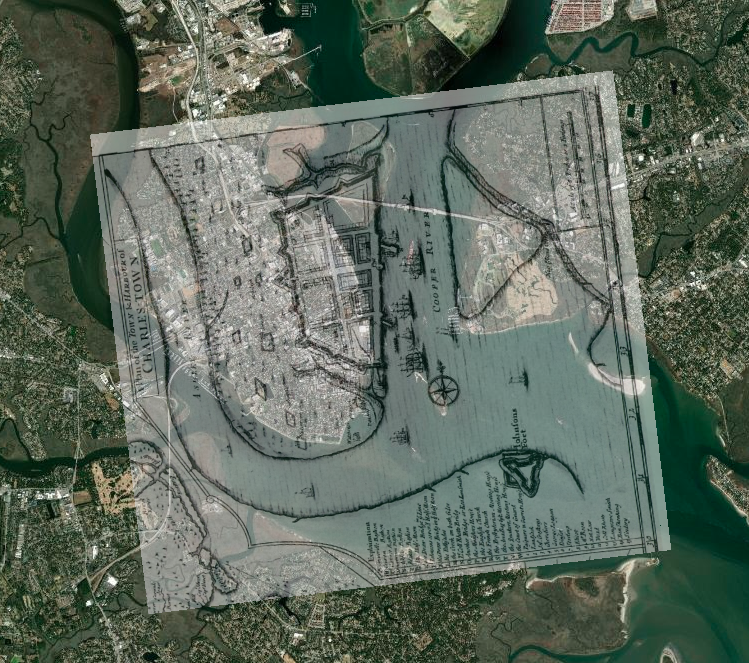
An historic, georeferenced map of Charleston Harbor (1711). From a student project by Kylie Gambrill.

Here are some examples from a recent class. I don’t want to make it seem like I’m taking credit for these. The students did the work. Catherine, Sam, and I were teammates. However, the examples are illustrative of the range of projects that are possible. The projects are easier to share, now that we have switched the delivery format from poster presentations to StoryMaps.

Charlotte Moore: Transit-Motivated Gentrification: An analysis of gentrification in Over-the-Rhine, especially as a result of the Cincinnati Streetcar.

Caroline Vickery: Contextualizing Upstate Farms: A preliminary examination of land use and nutrient loading for small farms in the Upstate of South Carolina.

Kylie Gambrill: Understanding Change: The Charleston Harbor — Our perceptions of the environment around us depend upon the cultural context we find ourselves in.

Bennett Dean: Affordable housing and public transportation in Greenville.

 Chloe Sandifer-Stech: Recommendations for green space around Enoree Career Center: A study of the influence of tree density on carbon storage.

Jake Gerardi: Land Sparing/Sharing Impacts on Birds: Assessing habitat quality of southern bird species using ecological principles in Greenville watersheds.

Madison Eichhorn: Affordable Housing & Good Jobs – An evaluation of proximity, density, and availability of affordable housing and employment.

Austyn Feigenbaum: Boating Safety Zones and Florida Manatees: An investigation on the relationship between manatee death rates and boating safety zones along the coast of Florida.

I hope you’ve enjoyed seeing the range of student projects and learning more. It’s a pleasure to see all the hard work result in such great studies and stories.

Highlights from the Future of Higher Education Forum

Image made available via CC license @ http://www.flickr.com/photos/feuilllu/5309422823/sizes/m/in/photostream/

Dan Cohen’s comments in the latest installment of the Digital Campus podcast prodded me to check out footage from George Mason University’s recent Forum on the Future of Higher Education.  I wanted to link to and highlight a few snippets that really resonated. A few notes:

*I have to admit that Dan jokingly referring to some of the discussion as being Jerry-Springer-like piqued my interest.  The discussion is actually very civil, and I appreciate Dan’s thoughtful skepticism.

*I haven’t watched all the footage. I saw individuals in the videos whose work I was familiar with (Dan Cohen, Bob Beichner, and Bryan Alexander) and tended to focus on their comments and responses to their insights.

*The video links in the titles below should take you to the appropriate spot in the conversation.  I make note of the time when the discussion shifts and you may want to stop and move on to the next snippet.

1. Context and Learning Environments:  (stop at 33:50) –  I like Dan’s focus on the university’s role in scaffolding and contextualizing information and reminding us that most learners need help with this.  Instructors as designers.

2. Measuring ‘Learning’ and Assessment:  (stop at 16:40) – Dan reminds us that focus on assessment (especially the easy to measure stuff) and learner analytics doesn’t paint a complete picture–not even close. He argues that a university also provides an environment for unexpected outcomes and ways of thinking—aspects of education that don’t lend themselves to tidy measurement.  This reminds me of a recent podcast by Freakonomics contributor Stephen Dubner in which he discusses lessons he uses everyday in his work with the professors who inspired the practice (even if they don’t remember the moment of inspiration!).

3. Student-Centered Instruction: (stop at 8:30) – Bob Beichner describes the SCALE-UP project at NC State, which utilizes problem-based-learning in large intro courses, and he shares how it’s working.  This design is being implemented at many schools across the country, including at nearby Clemson University. The model is adaptable to smaller classes.  Some classrooms would need some serious retrofitting to make this model possible, but it’s worth it.

4. Extending the Model Beyond STEM disciplines (stop at 1:04:45) – Bob shares how the SCALE-UP model can be used across disciplines. I really like how his example covers the entire learning cycle and mixes team and individual work.  Bryan Alexander compares technology use in the sciences and humanities.

5. MOOCs—It’s Complicated:  (stop at 41:35)  – Bryan provides a great overview of the different types of MOOCs, MOOC business models, and how colleges might leverage resources from MOOCs on campus. He also contextualizes several instructional technologies on the Gardner hype cycle.  Ah, the trough of disillusionment.


YoU(lysses): A Better MOOC?

Reading James Joyce’s Ulysses has been on my bucket list for several years; however, everything I’ve heard and read about the novel has left me hesitant to embark on the journey alone.  Now I’ve found some help.  Check out the Modernist Versions Project’s Year of Ulysses.  The website provides a schedule for reading, serial chapter releases of the original, online lectures, and periodic twitter discussions of the book.  So far, I’ve been keeping up with the reading and lectures, and I’ve found it really useful to have some additional background (and help!).  I initially read the PDF version of the releases but later found it more productive to read the free iBooks version, since it has an inline dictionary.  The reading pace outlined on the site is very reasonable, so I don’t have to abandon my other, lighter reading. This seems like a great model and somewhat more interactive than a traditional MOOC.

I’ve also enjoyed Jenny Colvin’s blog posts about her experience reading Ulysses. Jenny was kind enough to gift me some audible credits to get the audio version of the book.  Thanks Jenny! My plans are to revisit chapters I’ve read on a long run (once my achilles heals—kind of ironic).

Some bass-driven inspiration:

Nick Cave’s Night of the Lotus Eaters
Franz Ferdinand’s Ulysses

Image Credit: http://www.flickr.com/photos/48957186@N06/6940825627/

Transparency as the Catalyst to Transformation

I’m excited to host my first guest blog by colleague Diane Boyd, Associate Director for Furman’s Center for Teaching and Learning as she reflects on our trip with StudioLab consultants to ThatCamp Pedagogy.

Diane’s post:

THATCamp Pedagogy, Vassar College October 15-16

This was our first THATCamp, and many of us on the road to Poughkeepsie (including Mike Winiski, and student consultants Lacey Brantley, Shanda Edwards, and Boone Pilkington) from Furman’s Center for Teaching and Learning and StudioLab had some trepidation about creating an agenda for the meeting “on the fly” during the first session on Saturday morning.  Added to that low-level anxiety was wondering how to prepare for any impromptu presentations we might give at the conference or during “Dork Shorts.”

I was delighted at how well Matt Schultz orchestrated the schedule building on Saturday morning.  Participants suggested topics online before the meeting (and during our agenda making session) and those people were to take ownership of the session during the conference.  Logistically this worked well, except when a person suggested two sessions that got scheduled simultaneously (as was Mike’s dilemma with “Distant Reading” and “Interpreting Visualization”).  One suggestion: in some sessions it would be more effective to have a more deliberate matching mechanism.  That is, create the option for suggesting sessions without leading them:  people who suggest a session could request a co-facilitator/expert rather than become the session leader. I understand the non-hierarchical advantage to the current set up (which also promotes transparency!), but I also believe the current system prevented people who were genuinely curious about a topic from suggesting it (for fear that they would become intrepid leaders!)

Transparency, and in turn, transformation, emerged quickly as abiding conference themes. The BootCamps I attended provided ample time for brainstorming with fellow campers, and many transformative ideas for digital humanities projects were the result. In “Integrating Digital Projects into Undergraduate Courses” we focused on using audio recordings in a Latina Feminisms class.  The importance of “voice” for the professor made audio interviews a meaningful DH choice.  In “So Long, Lecture” another camper, also a student, talked about a prof who taught iambic pentameter by having her students walk to the beat.  Incorporating multiple senses as key to enduring cognition was useful to me as I plan a “Yoga in America” class where we engaged in daily physical practice a well as investigate the translation of traditional yoga to a Western, American lifestyle. Always our discussions began with the learning goals and then moved to the appropriate technology, if any, that would support the project.  Lacey, Boone, and Shanda agreed that it was transformative to “see behind the curtain”—watching professors struggle with the constraints of administrative demands while also attempting to build meaningful assignments that assist in the life long learning process.  And it was transformative for each of us to once again consider the transparency and integration of our roles at the Center for Teaching and Learning: we are at once teachers, learners, facilitators, experimenters, collaborators.  When we allow these roles to be fluid—when we take the risk to be transparent in our teaching, learning, and thinking—meaningful personal and professional  transformation are the inevitable result.